Mostrar mensagens com a etiqueta literatura colonial. Mostrar todas as mensagens

quinta-feira, 19 de novembro de 2015

"Aventuras de Dona Redonda", Virgínia de Castro e Almeida // "Adventures of Lady Round", Virginia de Castro e Almeida

O livro da publicação anterior (como insinuei em partes da resenha anterior, teve uma continuação), publicada logo no ano seguinte, 1943. Tendo sido logo publicada no ano seguinte, é surpreendente por um aspecto: a influência de um racialismo à nacional-socialismo pareceu desaparecer de todo. A Zipriti foi completamente redesenhada nas ilustrações (agora de outro autor mas de traço similar), parecendo agora nem ser mulata de todo (passando por assim dizer de caricatura de negra a boneca Emília d'O Sítio do Picapau Amarelo), Bonda desapareceu de todo não sendo sequer referido (Dick e Franz também não surgem, mas são insinuados em referências aos eventos do livro anterior nuns comentários de gente de fora da "gente" da personagem-título quando esta é pela primeira vez referida neste livro) e não surge qualquer racismo subentendido (a única figura subtextualmente estrangeira é Iria, a protagonista, que pode bem ser outra refugiada da II Guerra Mundial mas isto nem é aprofundado nem ela é apresentada negativamente). A actriz São José Lapa, que numa propriedade que lhe pertence na Margem Sul fez algumas representações ao ar livre de uma adaptação sua do 2.º dos dois livros da Dona Redonda, descreve que Virgínia de Castro e Almeida terá escrito este livro numa fase de ruptura com o Estado Novo; embora tal posição seja talvez um exagero (ainda vemos aqui uma certa crença na autoridade incontestável de quem "sabe mandar", no caso Dona Redonda), é verdade que surge um certo anarquismo filosófico, na forma como Dona Redonda organiza a sua comunidade à margem da sociedade, ignorando as críticas da "boa sociedade", adoptando várias crianças de várias etnias e raças (aqui Zipriti passando definitivamente da criatura quase sobrenatural do 1.º livro a uma incontestável criança apesar de continuar a ser um poço de sarilhos) e D. Redonda (como o livro em geral) humilham os aristocratas e as suas convenções (curiosamente aqui o racismo sendo passado para os ridículos opositores aristocráticos, que consideram bizarro Dona Redonda adoptar uma criança mulata), e que neste 2.º livro a aproximação da autora ao nazismo estava totalmente posta de lado.
O enredo deste livro, novamente não começa com a personagem-título, mas chega até ela, literalmente, envolvendo a viagem de uma criança até ela: desta vez é Iria, uma jovem que vivia numa pousada possuída por uma tal de Dona Catapulta no topo de um alto chamado Toutiço (i.e., topo de cabeça ou cocuruto), e uma manhã bem cedo ela sai da pousada e vai pelo caminho até encontrar um rapaz chamado Bruno e o seu cavalo Caracol. Os dois juntos encontram, depois de percorrerem casas com jardins tortos e um grupo de novos-ricos de manias bizarras, o Chico do primeiro livro, que os leva a casa da Dona Redonda. Depois disso há um enredo hilariante e errante envolvendo o casamento do Mostrengo, o dragão que serve a Dona Redonda desde o primeiro livro, obras na casa da Dona Redonda, novas adições à "gente" dela, o conflito com os aristocratas (que acabam tendo de ceder à aceitação dos valores da "gente" e humilhados vendo a linhagem verdadeiramente "sangue azul" da personagem-título que desprezavam), o encolher de Dona Redonda para ir visitar um formigueiro (talvez o momento mais anárquico e eventualmente anti-autoritário do livro, com uma crítica de uma organização social hierarquizada inflexível e a paródia de D. Redonda a ser confundida com uma deusa e uma loucura de destruição do formigueiro e 'distribuição de porrada' pela formigas de uma Redonda pelos cabelos com a estupidez das formigas é confundida pelas mesmas com uma dança divina; mas esta crítica continua a ser uma crítica de base religiosa e moralista mais que liberal ou laboral) mais viagens no tempo para ensinar história (agora grega antiga) e moral tradicional, e também para Chico, Iria e Bruno verem uma Dona Redonda mais nova no século XVIII num vestido com rabo postiço, e creio que a primeira aparição de um macaco no nariz na literatura portuguesa (num episódio de mijar a rir em que a incapacidade de remover um macaco do nariz que se prende na cara da criada dos aristocratas do enredo e da desistência dela de o tirar provoca o desmaio da patroa. Faz sentido no contexto). Como o livro anterior, este é um livro da tradição nonsense e por isso uma descrição de enredo a fundo é um pouco desnecessária no sentido em que o enredo é episódico, com vários fios e respectivas meadas e não um todo unido todo para um fim, o que não afecta porém a comicidade e valor de entretenimento deste livro em nada.
Virgínia de Castro e Almeida morreria em 1945, não se sabendo se o não surgimento doutro qualquer livro sobre esta personagem deveu-se ao não desejo de não escrever mais deles (ou mais livro nenhum) até morrer com 70 anos (não chegando ao aniversário a 24 de Novembro), ou se a morte a impediu de começar um novo (tem-se porém certeza que não tinha já começados apontamentos para nenhum livro novo da série). Mas felizmente que temos os dois livros desta série que temos, presentes em muitas bibliotecas municipais e escolares (como o livro anterior, principalmente na edição do início da década de 1990), com a Clássica Editora ainda vendendo este clássico do seu espólio escrito pela sua antiga directora, várias cópias pessoais encontrando-se à venda em sítios como o OLX.pt e o Coisas.com, e ainda as versões para download na Luso Livros.

A capa da edição dos anos '90 da Clássica Editora e a capa "modernizada" para a versão da Luso Livros


The book from the previous post (as I insinuated on parts of the previous write-up, had a continuation), published right-away on the following year, 1943. Having been published in the following year, it is surprising on one aspect: the influence of a racialism national socialism-style seemed to disappear at all. Ms. Zipriti was completely redrawn in the illustrations (nowby another author but of similar stroke), seeming now not even to be mulatta at all (passing so to speak from black-female's caricature to Doll Emilia from Yellow Woodpecker Ranch-farm). Bonda disaappeared at all not even being referred to (Dick and Franz also do not come-up, but are insinuated in references to the events from the previous book in some commentaries from folk from outside the title character's "folk" when she is for the first time referred on this book) and it does not come up any understated racism (the only subtextually foreign character is Iria, the lead, that may well be another World War II refugee but shuch is not deepened nor is she presented negatively). The Portuguese actress Sao Jose Lapa, who in an estate that belonged to her on the Tagus South Bank did some outdoors performances from an adaptation of hers of the 2nd of the two Lady Round books, describes that Virginia de Castro e Almeida would have written this book in a period of breakup with the Portuguese New State, although such position maybe would be an exageration (we still see here a certain belief on the undeniable authority of who "knows how to boss-around", in the case Lady Round), it is true that it comes up a certain philosophical anarchism, in the way how Lady Round organises her community at society's edges, ignoring the criticisms of the "good society", adopting several children from several ethnicities and races (here Zipriti passing definitely from the almost supernatural creature from the 1st book to an undisputed child despite cointinuing to be a paragon of troubles) and LY. Round (as the book in general) humiliate the aristocrats and their conventions (curiously here the racism being passed unto the ridiculous aristocratic opponents, who consider bizarre Lady Round adopting a mulatta child), and that on this 2nd book the author's rapprochement to nazism was totally set aside.
The plot of this book, again does not start with the title character, but gets to her, literally, involving the trip from a child up to her: this time it is Iria, a youngun that lived on a hostel possessed by one Lady Catapult at the top of a height called Mazard (i.e., head's top or head-dome), and one morning quite early she leaves the hostel and goes along the way till finding a boy called Bruno and his horse Curl. The two of them together find, after going through houses with crooked gardens and a group of nouveaux riches of bizarre manners, to Chico from the first book, who takes them to Lady Round's house. After that there is a hillarious and wandering plot involving the marriage of the Caliban, the dragon that serves to Lady Round since the first book, construction-works at Lady Round's house, new additions to her "folk", the conflict with the aristocrats (who end up having to give in tothe acceptance of the values of the "folk" and humiliated seeing the truly "blue blood" lineage of the title character that they despise), the shrinking of Lady Round to go visit an anthill (maybe the most anarchical and eventually antiauthoritarian moment from the book, with a criticism of an inflexible ranked social organisation and the parody of LY. Round being confused with a goddess and a madness of destruction of the anthil and 'distribution of whooping' among the ants by a Round up to the tips of her hair with the stupidity of the ants confused by the latter with a divine dance; but this critique continues being a critique of religious and moralist basis more than liberal or lib-labourite) plus time travel to teach history (now ancient Greek) and traditional morals, and also for Chico, Iria and Bruno to see a younger Lady Round in the 18th century in a dress with a pannier butt, and I believe so that the first appearance by a nose booger in Portuguese literature (in an episode to piss one's self in which the inability of removing a nose nooger that gets stuck on the face of the maid of the aristocrats of the plot and of her giving up on taking it out provokes the fainting of the lady-boss. It makes sense in context). Like the previous book, this is a book from the nonsense tradition and for that a description of plot in depth is a little unnecesary in the sense that the plot is episodic, with several threads and respective skeins and not a whole united all to one end, what doesn't affect though the comicalness and entertainment value of this book in anything.
Virginia de Castro e Almeida would die in 1945, not being known if the not appearing of any other book on this character owed itself to the none desire of writing more of them (or any other book) up till dying at 70 (not getting to her November 24th birthday), or if the death prevented her of starting again (it is had though certainty that she didn't have already started notes for any new book of the series). But fortunately that we got the two books of the series that we got, present in many Portuguese municipal and school libraries (like the previous book, mainly in the early 1990s edition, with the Clássica Editora publisher still selling this classic from its spoilage written by its former lady-director, several personal copies pessoais finding themselves for sale in sites like the OLX.pt and the Coisas.com, and yet the versions for download at Luso Livros.

A cover from the '90s edition by the Clássica Editora publisher and the "modernised" cover for the Luso Livros version

quinta-feira, 12 de novembro de 2015

"História de D. Redonda e da Sua Gente", Virgínia de Castro e Almeida // "Story of Lady Round and of her Folk", Virginia de Castro e Almeida

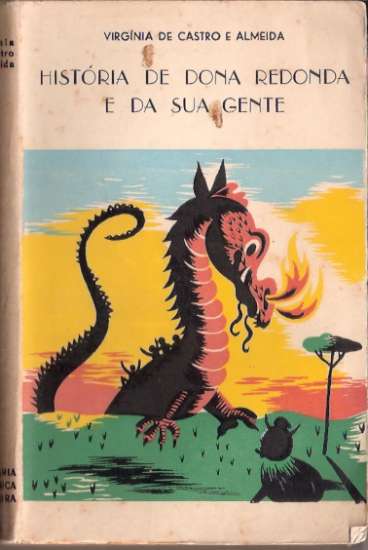
Na continuação da publicação anterior do blogue, hoje trago outro livro mais esquecido (embora mais acessível em bibliotecas municipais) que pode ser hoje algo mais polémico por evolução daquilo a que hoje se convenciona chamar "sensibilidades raciais". O livro de hoje é História de D. Redonda e da Sua Gente de Virgínia de Castro e Almeida, de 1942, escrito por uma autora originalmente notável pela sua ficção realista para crianças e por vários livros de história de Portugal (incluindo ensaios adultos) e que foi uma escritora, ao longo dos primeiros anos do Estado Novo, de uma série de romances ou de narrativas históricas romanceadas sobre vários períodos da nossa história, sempre vistos por um olhar patriótico e anti-liberal. Esta obra representou uma mudança interessante na obra desta autora: Virgínia de Castro e Almeida, que se estreara com o texto A Fada Tentadora sob o pseudónimo de Gy e depois recusara este texto como uma estreia menor, a princípio considerava que não se devia encher a cabeça das crianças de fantasias, assim as suas primeiras novelas infanto-juvenis (mais juvenis até) nos anos de 1890 e de 1900 eram narrativas realistas, passadas no mundo como o conhecemos, envolvendo protagonistas jovens, os seus guardiões adultos, viagens, e a apresentação dos jovens protagonistas a coisas reais de cada país e factos da ciência (efectivamente fazendo dela a "antepassado" da linha dos livros Uma Aventura de Ana Maria Magalhães e Isabel Alçada). Pelos anos de 1940, mais velha (e mais pesada; o texto parece insinuar que a Dona Redonda é um alter-ego da autora, como a sua amiga Dona Maluka é um alter-ego da sua amiga e ilustradora Inglesa), mudou de ideias quanto a isto, considerando o fantástico outro nível e forma de verdade, e portanto considerando aceitável o uso do maravilhoso e do irreal para crianças mais velhas e como forma de diversão e também de aprendizagem sobre a diferença real/irreal, sendo esta a sua primeira obra de fantasia desde a obra de estreia, sucedendo-se uma outra. 
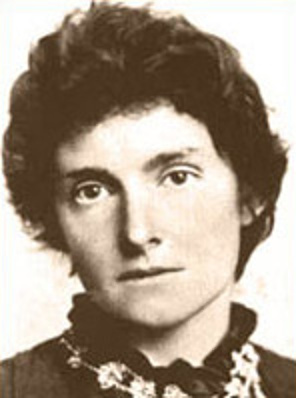
Fotografia e perfil da autora numa revista dos princípios do século XX
Torna-se também curioso reparar como esta evolução na obra da autora começou a dar-se com uma evolução ideológica da própria enquanto cidadã: os seus primeiros livros de aventuras juvenis realistas vinham da sua fase de republicanismo liberal e cooperativista, depois sucedendo-lhes livros narrativos ou ensaísticos de história pátria patriótica assinalando a sua evolução para o apoio da direita republicana e depois o Estado Novo (começando nas suas novelas de divulgação histórica o começo das suas cedências quanto ao realismo, embora devidas mais ao uso de linguagem rica de simbolismo do que por uso de maravilhoso irreal propriamente dito), e o seu regresso ao modo fantástico vem neste livro ao fim duma fase sua de quase "ultrapassagem pela direita" do Estado Novo (com aproximação do racialismo Nazi) e o seu segundo livro fantástico juvenil, também com D. Redonda, virá na altura de uma suave ruptura com o Estado Novo e adopção de um certo anarquismo filosófico ainda com espaço para patriotismo e tradicionalismo. E será isso que nos levará ao ponto polémico deste texto, mas já aí iremos...
Apesar de tudo isto, Virgínia de Castro e Almeida bem merecia ser ainda publicada e estar em todas as bibliotecas escolares, pelo papel notável que teve na evolução da literatura infanto-juvenil portuguesa. Ela foi a primeira escritora ou escritor em Portugal que não se limitou a registar contos tradicionais, a escrever livros de contos infantis originais, publicar pequenos volumes só com um conto ou a publicar teatro infantil ou poesia infantil, ajudando a impulsionar a prosa infanto-juvenil portuguesa com originais, longos (novelas e romances) e importando para Portugal o modelo da ficção infanto-juvenil e juvenil de aventuras britânico vitoriano e eduardiano, só uma ou duas décadas depois desse modelo de literatura cristalizar no final da época vitoriana e na passagem para o reinado do sucessor da Rainha Vitória Eduardo VII, sendo a Inglesa Edith Nesbit o paralelo principal da Portuguesa (França adoptava propriamente esse modelo na mesma altura em que de Castro e Almeida o trazia para Portugal: a literatura infantil/infanto-juvenil gaulesa era dominada por prosa longa ou curta tendendo ao moralista de influencia católica e dos contos tradicionais, com os autores mais aventureiros que hoje associamos a literatura para jovens como Júlio Verne na altura sendo considerados autores para adultos ou, vá lá, para jovens, o fosso entre literatura infantil e "genérica" sendo tão grande em França como cá); quem, seguindo o modelo britânico, ajudou a criar um meio-termo entre literatura infantil pura e literatura adulta (o vago conceito de literatura infanto-juvenil, e a criar um espaço "tampão" entre literatura infantil e adulta, a literatura juvenil) em Portugal foi Virgínia de Castro e Almeida, e dizer isto tudo ajuda a perceber a sua qualidade literária, dando para perceber que é uma autora de enredos mexidos, linguagem fácil sem ser facilitista, com enredo excitante e tudo o que se esperava dos melhores autores infanto-juvenis do final do século XIX e inícios do XX. Deve reconhecer-se porém que na lusofonia, Virgínia de Castro e Almeida tivera um precursor na adopção do modelo anglo-saxónico de novela fantástica infanto-juvenil, o Brasileiro Monteiro Lobato com A menina do narizinho arrebitado de 1922 (estreia de Narizinho e lançamento da série de livro sobre o Sítio do Picapau Amarelo).
E. Nesbit e Monteiro Lobato
Este livro passa-se em torno de Chico, um jovem Português que vai andando de bicicleta na floresta na região Oeste de Portugal, sonhando com aventuras caçando em África e afins, quando se encontra por acaso com Dick e Franz, um ruivo Inglês e um loiro Alemão, refugiados da II Guerra (sempre era 1942), e depois de uma breve discussão com o Inglês, os 3 ficam amigos e partem pelo mato em busca de pinhas (e pinhões) e quiçá de aventuras. Ora os 3 encontram em cima de uma árvore uma criança ainda mais nova, uma mulata que dá pelo nome de Zipriti. A partir daqui o livro não deixa ser complexado, visto que apesar de inofensivo, ganha aqui bastante subtexto e elementos claros que podem fazer impressão. Embora desde o princípio o trio seja um conjunto de personificações dos respectivos países e de conjuntos dos defeitos e qualidades estereotipados dos seus povos, isto é inofensivo até a personificação da África europeizada entrar em cena. Mas Zipriti até é uma personagem relativamente inofensiva visto que a sua personalidade quase hiperactiva faz dela interessante para o leitor, e a sua idade pode desculpar isto como caraterização realista de uma criança hiperactiva (apesar de não deixar de se ver assim personificada África como mais nova e mais infantil que os outros 3 países personificados pelas crianças brancas).
Zipriti nas ilustrações originais
Bem pior é quando surge um negro mais velho que trabalha na casa da D. Redonda (uma senhora gorda, redonda literalmente que nem uma bola que acolhe os 4 miúdos como "a sua gente" na sua casa), Bonda, uma figura quase tão infantil como Zipriti, que fala de forma parecida (menos desculpável num adulto), e reparamos que as ilustrações originais representam Zipriti e Bonda como outras "imagéticas darky" como referimos na publicação anterior. Mas pior talvez seja mesmo o que surge no "último acto" da novela: D. Redonda a certa altura começa a rir tanto que perde o juízo e cai ao chão e parte-se em fanicos, literalmente, partindo-se em muitas Donas Redondas pequeninas; os seus amigos guardam todas, e depois magicamente são levados a um caminho para a salvação da D. Redonda, contra vários desafios, e contra cada um, só um dos 4 (Chico, Dick, Franz e D. Maluka, Bonda e Zipriti sendo deixados para trás juntos com os Pikis, os cães de D. Redonda, o que também tem umas certas "implicações infelizes" em termos de subtexto) triunfa sobre o desafio em cada um deles, os outros 4 sendo derrotados por ele (dependendo da personalidade de cada um), e o desafio final, ultrapassado por Chico é um de humildade (de acordo com a imagem do Português humilde e de "pobreza digna") ante um adversário que parece saído de uma caricatura Nazi chamado «Isaac, o Rei dos Avarentos». Esta merece ainda mais um credo que o aspecto do Jobim d'O Pretinho de Angola.
Bem, fora todas estas questões, o livro é fortemente escrito no seu género para esta faixa etária, e é bastante fácil de ler e atraente, tendo várias sequências interessantes em que, depois de encontrarem Zipriti, os 3 rapazes encontram-se transportados no tempo magicamente, assumindo identidades adultas dentro dessas épocas históricas, viajando à conquista de Lisboa por D. Afonso Henriques, ao tempo do Infante D. Henrique como sábios que vão para a Escola de Sagres ver o retorno de marinheiros, e outras peripécias mais cómicas e "comezinhas". Como o livro da publicação anterior, com revisão das ilustrações e mudança neste caso da fala de Bonda (Zipriti como criança pequena ainda vá lá falar tanto na terceira pessoa, num adulto fica bizarro), podia ser um leitura popular. Este livro está presente em edições dos anos de 1990 em quase todas as bibliotecas municipais, e este livro e a sequela da mesma autora surgem também no sítio de downloads português Luso Livros, além de ter sido editada em Barcelona uma tradução castelhana ricamente ilustrada pelo ilustrador Espanhol Jorge Ravassa Masoliver que parece ter sido bastante popular com os leitores jovens locais.
 
Capa de uma edição dos anos de 1990 e a capa "modernizada" da Luso Livros


In the continuation of this blog's previous post, today I bring another book more forgotten (although more accesible in Portuguese municipal libraries) that can be today somewhat more polemic by evolution of what today is established to be called "racial sensibilities". Today's book is História de D. Redonda e da Sua Gente ("Story of Lady Round and of her Folk") by Virginia de Castro e Almeida, from 1942, written by an author originally remarkable for her realistic fiction for children and by several books of history of Portugal (including adult essays) and who was a writter that throughout the first years of the Portuguese New State, of a series of novels or romanced historical narratives on several periods of Portugal's history, always seen by an anti-liberal patriotic gaze. This work represented an interesting change on this author's work: Virginia de Castro e Almeida, who debuted herself with the text A Fada Tentadora ("The Tempting Fairy") under the pseudonym of Gy and afterwards refused that text as a minor debut, at first considered that one should not fill children's heads with fantasies, so her first children's/young-people's (and young-people's even) novellas in the 1890s and 1900s were realistic narratives, set in the world as we know it, involving young leads, and their adult guardians, travels, and the introduction of the young leads to real things from each country and science facts (effectively making her the "ancestor" of the line from the Uma Aventura/An Adventure books by Ana Maria Magalhães and Isabel Alçada). By the 1940s, older (and heavier; the text seems to insinuate that the Lady Round is an alter ego of the author's, as her Lady Krazy is an alter ego of her friend and English illustrator), changer her mind about that, considering the fantasy another level and form of truth, and hence considering acceptable the use of wondrous and of the unreal for older children and as form of amusement and also of learning on the difference real/unreal, being this her first work of fantasy since the debut work, following itself another one thus. 
Author photography and profile in an early-20th century magazine
It turns itself curious to notice how this evolution of the author's work started to give itself with the ideological evolution of herself while citisen: her first realistic young-people's adventure books came from her phase of liberal and cooperativist republicanism, afterwards following themselves to them narrative or essay-like patriotic fatherland's history books signaling her evolution unto the support of the republicsn rightwing and afterwards the Portuguese New State (starting in her historical popularising novellas the start of her yieldings about realism, although due more to the use of language rich on symbolism than for use of unreal wondrous proper), and her return to the fantasy mode comes in this book at the end of a phase of hers of almost "overtaking on the right lane" to the Portuguese New State (with approximation to the Nazi racialism) and of her second young-people's fantasy book, also with Dona Round, will come in the time-point of a suave break-up with the Portuguese New State and adoption of a certain philosophical anarchism still with room for patriotism and traditionalism. And it will be that that will take us to the controversial point of this text, but we shall get there...
Despite all this, Virginia de Castro e Almeida well does deserve to be still published and be in all the Portuguese school libraries, for the remarkable part that she had in the evolution of the Portuguese children's/young-people's literature. She was the first female or male writer that didn't limit one's self to record traditional tales, to write books of original children's tales, publish small volumes with just one short-story or to publish children's theatre or children's poetry, helping to boost the Portuguese children's/young-people's prose with originals, long ones (novellas and novels), and importing to Portugal the victorian and edwardian British adventure children's/young-people's and young-people's fiction model, onlu one or two decades after that literature model crystallising at the end of the victorian period and on the passage to the reign of the Queen Victoria's successor Edward VII, being the Englishwoman Edith Nesbit the main paralel to the Portuguese one (France adopted properly that model at the same time in which de Castro e Almeida brought it to Portugal: the Gaulish children's/children's & young-people's literature was dominated by long or short prose tending to the moralising of Catholic and traditional tale influence, with the more adventurous authors that today we associate to literature for youngungs like Jules Verne at the time being considered authors for grown-ups or, the farther, for young people, the chasm between children's and "generic" literature being so big in France as here); who, following the British model, helped to create a golden mean between children's and grown-up literature (the vague concept children's-juvenile literature, and to create a "buffer" space between children's and adult literature, the young-people's literature) in Portugal was Virginia de Castro e Almeida, and to say all this helps to understand her literary quality, aiding one to understand that she is an author of stirred plots, language easy without being laxed, with exciting story and all that is expected out of the best children's/young-people's authors from the late 19th century and early 20th. Must recognise itself though that on lusophony, Virginia de Castro e Almeida had a precursor at the adoption of the anglo-saxonic model of children's/young-people's fantasy novella,the Brazilian Monteiro Lobato with A menina do narizinho arrebitado/"The Girl of the Little Turned-Up Nose" from 1922 (debut of Lucia "Little Nose" and launch of the book series about the Sítio do Picapau Amarelo/"Yellow Woodpecker Ranch-farm").
E. Nesbit and Monteiro Lobato
This book is set around Chico, a Portuguese youngster that goes around by bicycle on the forest of the West region of Portugal, dreaming with adventures hunting in Africa and alike, when he finds himself by chance with Dick and Franz, a redhead Englander and a blonde German, World War II refugees (it was 1942), and after a brief discussion with the Englander, the 3 become friends and leave through the backwood looking for pinecones (and pine-nuts) and perhaps for adventures. Well now the 3 find on top of a tree a younger child, a mulatta that goes by the name of Zipriti. Starting from here the book cannot help being complexed, seen that despite harmless, it gains here quite some subtext and clear elements that might irk one's self. Although from the beginning the trio be an ensemble of embodiments of the respective countries and of ensembles of stereotypical shortcomings and qualities of their peoples, this is harmless till europeanised Africa's embodiment enters the stage. But Zipriti is quite a relatively harmless character seen that the almost hyperactive personality of hers makes her interesting for the reader, and her age can excuse this as realistic characterization of a hyperactive child (despite not helping the seeing thus personified to Africa as younger and more childish than the 3 other countries personified by the white children).
Zipriti in the original illustrations
Much worse is when it comes-up an older black-man that works at Dona Redonda's house (a fat lady, round literally as only a ball can be who takes in the 4 kids as "her folk" at her house), Bonda, a figure almost as childish as Zipriti, who talks in way like her (less excusable on an adult), and we notice that the original illustrations represent Zipriti and Bonda as other "darky imageries" as we refered on the previous post. But worse maybe would really be what comes up in the "last act" of the novella: Dona Round at a certain point start laughing so much she looses her sense and falls to the ground and breaks herself into bits, literaly, breaking into many tiny Lady Rounds; and her friends guard all of them, and afterwards magicall are taken to a pathway for the salvation of Dona Round, against several challenges, and against each one, only one of the 4 (Chico, Dick, Franz and Dona Krazy, Bonda and Zipriti being left behind with the Pikis, the dogs of Dona Round, what also has certain "unfortunate implication" in terms of subtext) triumphs over the challenge in each one of them, the other 4 being defeated by it (depending on each one's personality), and the final challenge, overcome by Chico is one of humility (in agreement with the image of the Portuguese humble and of "dignified poverty) before an adversary that seems come out from a nazi caricature called «Isac, the King of the Misers». This one deserves even more a darn than Jobim's look fro' O Pretinho de Angola/"The Little Negro from Angola".
Well, aside all these questions, the book is strongly written in its genre for this age group, and it is quite easy to read and attractive, having several interesting sequences in which, after finding Zipriti, the three boys find themselves transported in time magically, assuming grown-up identities within those historical times, travelling to the conquest of Lisbon by King Don Alfonso Henriques, to the time of the Infant-prince Don Henry as wisemen that go to the School of Sagres to see the return of sailors, and other mishaps more comical and "humdrum". Like the book from the previous post, with revision of the illustrations and change in this case of Bonda's speak (Zipriti as a small child still doesn't go too far she talking so much on the third person, on a grown-up it gets bizarre), could be a popular read. This book is present in editions from the 1990s in almost all Portuguese municipal libraries, and this book and the same author's sequel come-up also at the Portuguese download website Luso Livros ("Luso Books"), besides having been edited in Barcelona a Castilian Spanish translation richly illustrated by the Spanish illustrator Jorge Ravassa Masoliver that seems to have been popular local young readers.
 
Cover of one 1990s edition and "modernised" cover from Luso Livros

sexta-feira, 6 de novembro de 2015

"O Pretinho" de Angola", César de Frias // "The Little-negro from Angola", Cesar de Frias

A história dos negros no Império Português tem andado a ser feita a várias velocidades. Obviamente as historiografias dos PALOPs têm feito uma boa cobertura da história pré-colonial e colonial das suas populações africanas, e no Brasil desde o surgimento de um movimento negro de inspiração norte-americana que têm sido feitos esforços de escrever a história negra no Brasil. A história dos negros em Portugal em si, continente e ilhas, essa história tem sido menos explorada. Por razões óbvias, a começar porque Portugal enquanto império estava bastante "segregado" geograficamente (o grosso da população branca estava no território europeu, o grosso da população negra estava em África ou enviada para trabalho escravo no Brasil, com excepções de população colonizadora branca fora da Europa e alguns escravos ou negros livres, ex-escravos ou não, no Portugal europeu), depois o facto de não haver registos muito precisos sobre a população pré-moderna de Portugal e quanto a envios de negros escravizados ou chegada de embaixadores de reinos negros ou afins não permite ser muito detalhado (no século XVII calcula-se que só os escravos africanos eram 10% da população de Lisboa, 10 mil escravos, mas não se tem certeza quantos africanos libertos haviam e se de facto a quase totalidade dos negros em Portugal estavam em Lisboa) excepto se o historiador quiser ser bastante extrapolador e imaginativo mais do que devia, e acima de tudo porque a presença ou visita por negros antes do século XX ou XXI foi "vítima" de mistificações por razões ideológicas de vários tipos: entre ultra-nacionalistas, qualquer presença africana antes da descolonização ou da construção da Zona J de Chelas era inexistente ou residual (e essa é uma nação pura étnica e culturalmente a emular), entre activistas anti-racistas pelo contrário imagina-se uma mítica população 15% negra (portanto ainda maior que a população permanente actual segundo a maioria das estimativas) em pleno século XV (e um mítico Portugal "antigo" com uma população negra contínua e enorme histórica é apresentada como modelo a emular para o Portugal actual), quando qualquer observador neutro admitirá que ninguém poderá indicar números exactos e não havia nenhuma população permanente visto que a maioria seguia os endinheirados que partiam para as colónias ou pela Europa fora e a maioria era enviada para servidão no Brasil ou o estrangeiro e não Portugal, daí que em dias de grande tráfego de barcos negreiros para Lisboa, num dia até podia a população de Portugal triplicar só por chegada de escravos, a maioria dos quais podia já nem estar no país no dia seguinte.
Assim esta questão que devia ser meramente estatística e histórica sofre de debates ideológicos que lhe deviam ser alheios, e por exemplo, mesmo entre anti-racistas há um bipolarismo entre dizer que Portugal é um Estado construído sobre imperialismo, opressão e racismo, e que Portugal apesar de tudo isso nalguma forma tem um passado de país de inserção de população africana e que o Portugal de hoje é que tem uma "amnésia histórica" e se esquece que o negro nunca foi estranho ao país (usando no fundo a mesma lógica dos ultra-nacionalistas: a história e a tradição são base de tudo, e o presente deve ser conforme um passado idealizado que nunca existiu). A verdade encontra-se algo entre os dois polos: obviamente que antes dos anos '90 a população negra (como aliás toda a não-branca ou não-Portuguesa) permanente era residual, nem 1%, havendo excepções como negros que tinham acompanhado os Portugueses de África radicados na Europa com a descolonização, velhos criados escravos e seus descendentes, pequeno número de mulatos e mestiços afins, sendo que apesar de haver negros residentes desde o século XV, normalmente eram criados ou escravos que morriam como tal e não tinham (devido ao número de negros em Portugal e ao facto de muitos dos libertos virarem clérigos e portanto deixar descendência não era opção) grande capacidade de se reproduzirem e criarem uma geração seguinte nativa de Portugal (pelo que apesar de haver residentes negros desde essa época recuada, é mais provável haver hoje brancos descendentes de algum desses do que algum Português negro actual ser herdeiro destes, e mesmo esses brancos, como no caso da gente de São Romão na Margem Sul recuam a ascendência só ao século XVIII e não XVI como antes se pensava), e embora o negro fosse um outro à margem da sociedade, isso era mais notado com as primeiras gerações que vinham da África islâmica ou animista e portanto estavam cultural e religiosamente mais separados do Portugal culturalmente europeu e religiosamente católico, havendo porém "portas" abertas para alguma possibilidade de integração social (como hoje, ser africano e rico era uma coisa diferente, além de que nos tempos antes do surgimento do "racismo científico" oitocentista a integração do negro por assimilação cultural/religiosa e casamento com brancos da mesma classe social era mais aceitável e sobrepunha-se à questão étnica).
A imagem na cultura portuguesa dos negros assim oscilou sempre entre "o outro" e alguém digno de solidariedade e "assimilável". O documentário As Jóias Negras do Império de Anabela Saint-Maurice (parte da série O Lugar da História da RTP nos anos de 1990 e início deste século) faz não só um bom relato da história de alguma população negra de Portugal e da escravatura em geral no Império Português como nos mostra algumas imagens na publicidade portuguesa, não só em anúncios míticos como o da Pasta Medicinal Couto como outros menos vistos que usam da iconografia que os Anglo-Saxónicos chamam "darky imagery" ou "imagética de escurinho" (termo em Portugal menos usado e portanto até em muito PNR criou estranheza quando Arménio Carlos o usou). Ora, embora o lusotropicalismo tenha os aspectos de mito exagerado conhecidos, não deixa de ser estranho ver "imagética de escurinho" em Portugal, para começar porque havendo bastante menos negros no Portugal europeu, não daria tanto "gozo" racista gozar com uma população que maioritariamente não estava cá para ser ofendida, segundo essa imagética era no fundo uma "americanice", que era adoptada na Europa e mesmo Ásia só ocasionalmente e por "globalização" e quase como referência propositada a produtos norte-americanos, e por fim porque para anúncios de marcas que serviam populações das colónias por vezes o grafismo era suavizado porque, em África, o negro era potencial comprador, e não se podia "gozar" com o cliente mesmo que de facto o vendedor o achásse sub-humano, e principalmente depois da II Guerra Mundial Portugal tentava rever a imagem do africano para propagandear um Portugal multirracial e pluricontinental.
É por causa disso tudo (perdoem-me estes preliminares) que este livro é tão estranho: apesar do título (lembremos que na altura "preto" era o termo standard para negro) o livro é relativamente progressista (embora incontestavelmente paternalista) para a época (1930), apresentando a personagem título como um "poço de virtudes", o verdadeiro herói do livro, que surge muito mais virtuoso que o menino branco com que começamos o livro mas ele tem... este aspecto... 
Ora é este o nosso herói, Jobim. Credo. Olhem só para isto. Olhem. Apesar disto, o enredo desta novela infantil em si é bastante agradável: Nini, o filho de uma família de colonos brancos em Angola, recebe como presente de Natal a companhia de um órfão negro, Jobim (embora ver um subtexto de escravatura "benevolente" aqui seja natural, César de Frias, novelista notório na sua época e tão esquecido poucos anos depois que ninguém sequer sabe quando morreu, trata a relação de ambos de forma delicada e natural), sendo que ele vê dita companhia como um mero presente e "objecto", porém a cada peripécia ele Nini surge com mais defeitos e Jobim surge mais dignificado e bom, acabando a criança branca por deixar de parte os seus defeitos e tornar-se mais virtuoso, envergonhando-se do seu eu passado e também por exemplo do "pretinho" Jobim. Apesar da evolução do mundo, como as aventuras indianas de Rudyard Kipling, esta novela poderia ler-se bem hoje em dia, mas precisaria claro de mudar o título para "O Negrinho de Angola". E de mudar desesperadamente de ilustrações. A sério, é difícil levar Jobim a sério como personagem digna quando ele tem esta fronha. Diz-nos muito sobre a evolução do "país e do mundo" como diria Rodrigo Guedes de Carvalho o facto de em tempos jornais publicitarem este livro louvando as ilustrações.


The history of blacks in the Portuguese Empire has been going being made at several speeds. Obviously, the historiographies of the PALOPs (Países Africanos de Língua Oficial Portuguesa, "African Countries of Portuguese Oficial Language) have been doing a good coverage of the precolonial and colonial history of their african populations, and in Brazil since the appearance of a North American inspired black movement that there have been made efforts of writing the black history in Brazil. The historh of black in Portugal itself, continent and islands, that history has been much less explored. For obvious reasons, starting because Portugal while empire was rather geographically "segregated"(the thick of the white population was on the european territory, the thick of the black population was in Africa or sent for slave work on Brazil, with exceptions of white colonising population outside of Europe and some slaves or black free, ex-slaves or not, on the european Portugal), following the fact that there are not very precise records on Portugal's premodern population and about the shippings of enslaved black or arrival of ambassadors from black kingdoms and alike does not permit to be very detailed (in he 17th century it is measured that the african slaves alone were 10% of Lisbon's population, 10 thousand slaves, but it is not quite certain about how many freed african slaves there were and if in fact the almost totality of the blacks in Portugal were in Lisbon) except if the historian wants to be quite extrapolator and imaginative more than one should be, and above all because the presence or visit by blacks beforethe 20th or 21st century was "victim" to mystifications for ideological reasons of several types: among ultranationalists, any african presence before the Portuguese decolonisation or the construction of the Zona J neighbourhood from the Chelas place was inexistent or residual (and that is a ethnic and culturally pure nation to emulate), among antiracist activists on the contrary it is imagined a mythical 15% black population (hence even bigger than the current permanent population according to most estimates) in full-on 15th century (and a mythical "ancient" Portugal with a continuous and enormous is presented as model to emulate for the current Portugal), when any neutral observer will admit that nobody can indicate exact figures and there was no permanent population seen that the majority followed the moneyed who parted for the colonies or throughout Europe and the majority was sent to servitude in Brazil or abroad and not Portugal, hence that in days of large transit of black-slaver boats to Lisbon, in one day it could well the population of Portugal triple only by the arrival of slaves, the majority of which could not even be in the country on the following day.
So this issue that should be merely statiscal and historical suffers with ideological debates that should be outward to it, and for example, even between antiracists there is a bipolarism between saying that Portugal is a state built on imperialism, oppression and racism, and that Portugal despite all that in some way has a past of country of insertion of african population and that the Portugal of today as a "historical amnesia" and forgets itself that the black was never foreign to the country (using at the end of it the same logic of the ultranationalists: history and tradition are basis of everything, and the present must be according to an idealised past that never existed. The truth finds itself between the two poles: obviously that before the '90s the permanent black population (as by the way all the non-white or non-Portuguese population) was residual, not even 1%, there being exceptions as blacks tat had accompanied the Portuguese from Africa established in Europe with the Portuguese decolonisation, old servants or slaves an their descendants, small number of mulattos and alike halfbreeds, being that despite there being resident blacks since the 15th century, normally they were servants or slaves that died assuch and didn't have (due to the number of black in Portugal and to the fact of many of the freedmen turning clerics and hence leaving descent wasn't an option) much capacity of reproducting and raising a following generation native to Portugal (so that despite there being black residents since that far-back period, it is more likely today to have whites descendentes from some of those than some current black Portuguese being heirs to those, and even those whites, as in the case of the folk of Sao Romao on the Tagus South Bank go back their ancestry just to the 18th century and not 16th as earlier thought), and although the black-man were one other at the margin of the society, that was more noticed with the first generations that came from the islamic or animist Africa and hence were culturally and religiously more separated from the culturally european and religiously Catholic Portugal, there being "doors" open to some possibility of social integration (as today, being african and wealthy was a different thing, besides that in the times before the comingup of the eighteen-hundredth "scientific racism" the integration of the black-man by cultural/religious assimilation and marriage with whites from the same social class was more acceptable and overlayed itself to the ethnic issue).
The image in Portuguese culture of the blacks so oscillated between "the other" and someone worthy of solidarity and "assimilatable". The documentary As Jóias Negras do Império (""The Empire's Black Jewels") by Anabela Saint-Maurice (part of the series O Lugar da História from the RTP TV in the 1990s and beginning of this century) does not just good report of the history of some black population of Portugal and of slavery in general in the Portuguese Empire as it shows us some pictures on Portuguese advertisement, not only in mythical ads like Pasta Medicinal ("Medicinal Tooth Paste") Couto's one as others less seen that use of the iconography that the anglo-saxonics call "darky imagery" or in Portuguese "imagética de escurinho" (term in Portugal less used and hence even in many a National-Renovator-Partisan it created strangeness when Communist trade unionist Arménio Carlos used it). well, although lusotropicalism has the known aspects of exagerated myth, it doesn't cease being strange seeing "darky imagery" in Portugal, for starters because there being rather less blacks in european Portugal, it would not give as much racist "kicks" to mock a population that mostly was not here to be offended, second that imagetic all in all was an "americana", that was adopted in Europe and even Asia only occasionally and by "globalisation" and almost as purposeful reference to North American products, and at the bottom of it because for commercials of brands that served populations from the colonies sometimes the graphics were softened because, in Africa, the black was a potential buyer, and one could not mock the client even if the seller indeed thought of him as subhumanm and mainly after World War II Portugal tried to revise the image of the African for propagandising a multirracial and pluricontinental.
It is because of all that (forgive me these foreplays) that this book is so strange: despite the title (let us remember that at the time-point "negro" was the standard term for black) the book was relatively progressive (though undisputedly paternalistic) for the period (1930), presenting the title character as a "paragon of virtues", the true hero of the book, that comes-up much more virtuous than the white little-boy we start the book with but he has... this look... 
Well this is our hero, Jobim. Darn it. Just look at this. Look at it. Despite this, the plot of this children's novella is quite agreeable: Nini, the son of a family of whit settlers in Angola, receives as Christmas present the company of black orphan, Jobim (although seeing a subtext of "benevolent" slavery here be quite natural, Cesar de Frias, notorious novella-writer in his period and so forgotten few years after that nbody even knows when he died, treats the relation of both in delicate and natural way), being that he sees said company as mere present and "object", yet at each mishap he Nini comes-up with more flaws and becoming more virtuous, shaming himself on his past self and also by example of the "little-negro" Jobim. Despite the world's evolution, as with Rudyard Kipling's Indian adventures, this novella could well be read nowadays, but would need of course to change the title for "O Negrinho de Angola" ("The Black Little-Boy". And to change desperately illustrations. For real, it is hard to take Jobim seriously as a worthy character when he has this mug. It tells us much on the evolution of "the country and the world" as would say Portuguese anchorman Rodrigo Guedes de Carvalho the fact that times aback newspapers advertising this book praising the illustrations.

sexta-feira, 18 de setembro de 2015

"Filha de Branco", Reis Ventura // "Whiteman's Daughter", Reis Ventura

As peripécias coloniais são frequentes, como temos visto, nas obras que têm passado pelas publicações deste blogue. Isto é compreensível dado o passado de Portugal e a forma como a colonização (ou pelo menos algum tipo de imperialismo) em geral representou o passado de muitos povos do mundo, e enriqueceu muitos povos enquanto enfraqueceu muitos outros na 'outra ponta' do processo, pelo que tornou-se um tema muito atraente para os artistas em geral, sob vários prismas. Filha de Branco (Cenas da vida de Luanda), publicado originalmente em 1960 de Reis Ventura (que já foi apresentado na 9.ª publicação deste blogue), é no espírito desses livros centrados no tema da colonização e das suas consequências negativas e positivas e dos "produtos" (até humanos) do encontro entre mundos diversos. O livro fecha uma trilogia de Reis Ventura, Cenas da Vida Em Luanda, trilogia que mostra a realidade das três classes sociais na capital da então Angola Portuguesa entre as décadas de 1920 e de 1950, um volume dedicado à classe baixa (o livro aqui em causa), outro à média e outro à alta, enquanto se começa a formar uma luta por independência numa colónia com vários problemas.
Este último livro da trilogia representa a mestiçagem racial nos bairros limítrofes de Luanda. É aí, na «vasta área» dos chamados muceques (que o autor chamava «a parte mais original da cidade», que lembra «um formigueiro humano em que caldeia a Angola do futuro»), S. Paulo, Vila Clotilde, Muceque Rangel e Casa Branca, que surge no «centro nervoso» da área a Rua de S. Paulo («Ainda não é bem cidade; e já não pode chamar-se muceque») em que lavadeiras negras aposentadas arrendavam casas a brancos a quem curiosamente chamavam de patrão quando reclamavam pela renda atrasada. Nesses bairros de transição «cheios de pitoresco e de imprevisto», com cabanas de adobe ao lado de vivendas modernas, brancos "fura-vidas" e negros culturalmente ocidentalizados (e alguns proto-nacionalistas, membros da «Liga Africana» de então), já previa o autor o fermentar de um «país luso-tropical do porvir», em que brancos e negros interagiam de formas complexas e nem sempre idílicas (note-se que Reis Ventura, apesar de defender a supremacia e domínio português até o final da vida, já anos depois da descolonização, não defendia a segregação dentro das colónias e frequentemente mostrava os brancos pobres e os negros não-de elite local como tendo de se unir para conseguirem sobreviver ante as "vistas curtas" e políticas da burocracia colonial de Luanda, mas reconhece as actividades muitas vezes de oposição, comércio, competição, orgulhos isolacionistas e desigualdades que ocupam frequentemente o lugar que a cooperação devia ter). No amadurecimento do reconhecimento da realidade africana na escrita de Portugueses de África como Reis Ventura, vemos curiosamente um escritor Português, branco, a reconhecer algo que seria parte do protesto dos nacionalistas negros contra um certo segmento da população africana: as mestiças que eram tidas como ambiciosas (terminologia usada mesmo por Reis Ventura) «que tem no sangue a turbulência dos batuques, mas só quer um branco», o que os nacionalistas acusavam como rejeição da parte negra da suas pessoas e como sujeição a uma espécie de influência da hierarquia colonial na vida amorosa e sexual.
Filha de branco não refere-se só à personagem-título em causa (e representada na capa), mas como apontava o próprio Reis Ventura na introdução, «Filha de branco» é «esta Luanda dos Muceques (...) estranha mistura de arraial minhoto e de batuque de sanzala, de mercado indígena e de feira algarvia». Relato datado mas guiado por boas intenções e uma mundo-visão que embora não desafiando a posse colonial de Angola mostra simpatia pelos indígenas e mostra uma vida colonial portuguesa com muitos problemas sociais. Este e outros textos de Reis Ventura, que não importam para aqui, mas que revelam todos a mestria do autor na narração e na escrita (que chegou até ao cinema português em A Voz do Sangue de 1966), e que mais pátina menos pátina do mundo pós-colonial (e mesmo assim há livros muito mais datados vindos já no período pós-colonial como Ilha do meio do mundo do folclorista e escritor Católico Fernando Reis, ainda saudosita colonial em pleno 1982), na discussão da lusofonia e da relação Portugal-África (que hoje parece ser como a protagonista e o Muceque, «Filha de branco, que ficou só, e de preta que não quis resistir...») serão óptimo alimento-para-pensamento. Este livro é raro em bibliotecas (nas de Barcelos e de Braga está completamente ausente, estando porém presente na Biblioteca Nacional de Portugal não só este livro, mas um livro homónimo diferente assinado pelo pseudónimo de autor/autora Lília da Fonseca).


The colonial mishaps are frequent, as we have seen, in the works that have passed by the posts of this blog. This is understandable given Portugal's past and the way how colonisation (or at least some type of imperialism) in general represented the past of many of the world's peoples, and it enriched many peoples while it weakened many others on the 'other end' of the process, for what it became a very atractive theme for the artists in general, under several prisms. Filha de Branco (Cenas da vida de Luanda) (Whiteman's Daughter (Scenes from Luanda's life)", published originally in 1960 by Reis Ventura (who had already been introduced on this blog's 9th post), is in the spirit of those books centered on he theme of colonisation and of its negative and positive consequences and of the "by-products" (even human ones) of encounters between unlike worlds. This book closes a trilogy by Reis Ventura, Cenas da Vida Em Luanda ("Scene from Life in Luanda"), trilogy that shows the reality of the three social classes on the capital of the then Portuguese Angola between the 1920s and the 1950s decade, a volume dedicated to the lower (the book here at stake), another to the middle and another to the upper class, while it started to form itself the independence struggle in a colony with several problems.
This last book of the trilogy represents the racial crossbreeding in the liminal neighbourhoods of Luanda. It is there, in the «wide area» of the so-called muceques slums (which the author called «the more original paart of the city»), Sao Paulo, Vila Clotilde, Muceque Rangel and Casa Branca, that comes-up on the «nerve centre» of the Sao Paulo Street area («It still is not quite city; and it no longer can call itself muceque slum») in which retired black washerwomen rented houses to whites to whom curiously they called boss while they complained on the late rent. In those transition neighbourhoods «full of picturesque and of unforeseeable», with adobe huts alongside modern villas, "hustling" whites and culturally westernised blacks (and some proto-nationalists, members of the «African League» from back then), already predicted the author the fermenting of a «luso-tropical country of the hereafter», in which whites and blacks interacted in complex and not always idyllic ways (let it be noted that Reis Ventura, despite defending the Portuguese supremacy and domain till his later life, already years after the Portuguese decolonisation, did not defend the segregation within the colonies and often showed the poor whites and the local non-elite blacks as having to unite themselves for being able to survive in face of the "short sights" and policies of the Luanda colonial bureaucracy, but recognises the activities many times of opposition, commerce, competition, isolationist prides and inequalities that occupy freuently the place that cooperation should have). In the maturing of the recognition of the african reality in the writing of Portuguese from Africa like Reis Ventura, we see curiously a Portuguese, white, writer recognising somthing that would be part of the protest of the black nationalists against a certain segment of the african populations: the halfbreeds that were held as ambitious (terminology used actually by Reis Ventura) «that has in the blood the turbulence of the drumbeats but, only fancies a whiteman», what the nationalists accused as rejection of the black partt of their personhoods and as suggestion to a kind of influence of the colonial hierarchy into the love and sexual life.
Whiteman's Daughter doesn't refer itself just to the title character at stake (and represented on the cover), but as pointed Reis Ventura himself in the introduction, «Whiteman's daughter» is «this Luanda of the Muceques (...) strange mixture of Minho region country-set-dance and of sanzala village drumbeat, of indigenous market and of algarvian fair». Report dated but guided by good intentions and a worldview that although not challenging the colonial possession of Angola shows sympathy for the indigenous ones and shows a Portuguese colonial life with many social problems. This and other texts by Reis Ventura, which do not matter here, but reveal to all the author's maestry in narration and in writing (which got to Portuguese cinema in A Voz do Sangue/"The Voice of the Blood" from 1966), and that more patina less patina (and even so there are books much more dated coming already in the postcolonial period like Ilha do meio do mundo/"Island from the world's end" by the folklorist and Catholic writer Fernando Reis, still colonial nostalgic in mid 1982), in the lusophony discussion and the Portugal-Africa (that today seems to be as the protagonist and the Muceque, «daughter of whiteman, who was left alone, and of black-woman who didn't want to resist...») will be great food-for-thought. This book is rare in Portuguese libraries (in the Barcelos and Braga ones it is completely absent, being though present in the Portugal National Library not only this book but a different namesake book signed by the penname of male/female author Lilia da Fonseca).

terça-feira, 30 de junho de 2015

"Cafuso", Reis Ventura // "Free-Moor", Reis Ventura

Reis Ventura, o escritor hoje pouco recordado (fora o facto de ser polemicamente recordado como o poeta medíocre que bateu Mensagem de Fernando Pessoa para o Prémio Antero de Quental de Poesia de 1934, um evento muito mitificado e que é exposto mais detalhada e correctamente no sítio da Fundação António Quadros), mas literáriamente interessante (principalmente como prosador; como introdução. Manuel Joaquim Reis Ventura er um natural de Calvão, localidade de perto de Chaves, onde dá nome a uma rua, que se mudou para Angola, à qual dedicou boa parte da obra, sendo dos autores do Portugal colonial, e mesmo pós-colonial, que mais dedicou obras a este local e aos diversos tipos da população da época colonial deste país, incluíndo a indígena negra, e retornou a Portugal só após a independência do território, como parte dos duvidosamente chamados, como algo falsamente monolítico, "retornados", tendo vivido entre 1910 e 1988, quando faleceu em Oeiras), surge aqui com este romance pela primeira vez numa publicação do blogue Classicos da literatura infanto-juvenil portuguesa // Portuguese children's/juvenile lit classics.
Aqui ele dá-nos a estória algo autobiográfica de um colono Português de Angola, José da Silva (que é o próprio narrador da estória em que é protagonista, e é uma personagem com perfil bastante próximo do próprio autor, podendo dizer-se que só falta ele ter sido poeta e tirado um prémio de poesia a Pessoa); esta linha de inspiração autobiográfica começara na obra de Reis Ventura logo no seu poema de estreia premiado A Romaria (livro com probabilidade de achar em bibliotecas um pouco ao nível de Cafuso, isto é, não sendo "banal" achá-lo mas sendo algo comum), em que narra a viagem de um grupo de personagens, incluindo jovens de vocação religiosa como este José da Silva, que também viajam e encontram os seus caminhos enquanto se opõem a inimigos da "política do espírito" nacional da altura como uma personagem que representa um Bolchevique, e surgiria novamente nalgumas das suas obras ficcionais em prosa, obviamente inspirado pelos relatos na primeira pessoa que enquanto jornalista se habituara a escrever (devo notar que para não 'sobrecarregar' este blogue com obras de Reis Ventura, nenhuma destas outras obras autobiográficas será aqui analisada).
Reis Ventura (cerca dos anos de 1950?)
Os leitores (todos vocês os 5) já conhecedores de Reis Ventura abre o livro esperando intriga, alguma aventura e "cor" local e de uma época colonial já há muito terminada para sempre, e no essencial "recebe em troca" da atenção dada ao livro isso tudo. O livro começa com José da Silva Taveira a descrever como tem «alguns estudos» e cursou Filosofia no Colégio (franciscano) de Santo António em Tuy, perto da fronteira com Portugal, onde tem o sonho de se formar no seu caminho planeado do sacerdócio. Eventualmente, José da Silva relata-nos a sua evolução de aspirante a padre, a aluno dos Franciscanos, a desencantado com a vocação, até deixar Tuy, voltar a Portugal e daí partir para Moçambique, e três anos depois para Angola, onde se radica de forma prolongada (tudo coisas que o próprio Reis Ventura vivenciou, antes e depois do ano da sua transição para África, 1934).
Boa parte do início do livro é constituída pela experiência seminarista do jovem José, e esta é representada de forma fortemente irónica e que provavelmente manterá o interesse do leitor e lhe estimulará ao riso (pelo menos a mim assim foi). Veja-se assim esta cena para prova:
«Entrei, muito acanhado, na pobre saleta, famosa em toda a aldeia pela sua mesa de centro e alguns móveis desirmanados que meu pai trouxera do Brasil. O sr. Padre Inocêncio lá estava, alto e encorpado, com a testa rompendo até à coroa por entre duas farripas altas de cabelos, a fitar-me com os olhos bondosos, por baixo das sobrancelhas espessas. Naquela sua voz sonora de prègador de nomeada, perguntou-me logo, sem rodeios:
– O menino quer ir para o colégio?
Colhido de surpresa, derivei para minha mãe um olhar indeciso.
– Vá, responde! – encorajou ela.
Na minha consciência infantil, entendi que me destinavam para padre. Ràpidamente, corri os olhos cobiçosos pela grande fila de botões que o austero franciscano ostentava na batina. Lembrei-me dos puxões de orelhas que tinha apanhado pela mania de tirar à braguilha das calças o material para o jogo do botão. E, no meu íntimo, concluí:
– "É furo!"
O sr. Padre Inocêncio, bem longe dos meus silenciosos cálculos, ergueu-me o queixo com dois dedos amáveis e, olhando-me com bondade, proferiu:
– É um colégio muito grande, numa cidade muito bonita. Queres ir?
Mirei-lhe novamente os botões da batina. Caramba! Eram mais de vinte, alinhados, pretos, luzidios... E, resolutamente, respondi:
– Eu quero, sim senhor.»
Esta parte da vida de José, da decisão de entrar para o colégio franciscano até à saída do mesmo, é essencialmente toda narrada neste tom, por vezes mais abertamente comicamente mas de forma sempre algo similar. Se isso é bom na "lista" do leitor, isso já dependerá de cada um. Um episódio mais notável e mais sério é o da paixoneta juvenil frustrada de José por uma Flaviense chamada Isa.
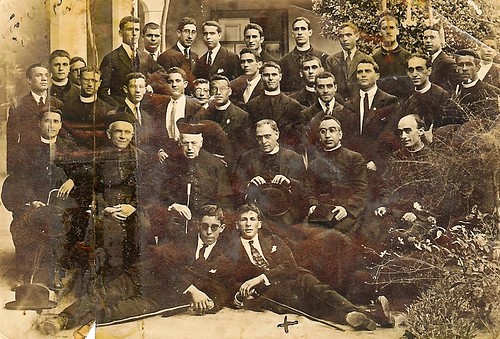
Fotografia de Reis Ventura nos tempos de seminário com os professores clérigos e os outros colegas de curso
De certa maneira, a representação social passando ao longo de vários ambientes sociais e a presença da sociedade africana (no meio e final do livro) pode recordar um leitor de outro livro de Reis Ventura, Filha de Branco, que espero que também venha a passar por este blogue (embora no caso de Cafuso este seja menos episódico e feito de quadros e seja mais de enredo coeso), e ambos os livros têm protagonistas dos quais sabemos q.b. da sua vida antes do início da narração mas que conhecemos principalmente pelo que o próprio enredo e as suas acções nos dizem das suas personalidades (de certa forma ainda em formação ante a realidade que confrontam, principalmente no caso deste José da Silva Taveira, que começa o livro ainda adolescente e que vemos crescendo até à idade adulta ao longo do enredo), e quer da Silva Taveira quer os múltiplos habitantes do muceque em Filha de Branco se assimilam com a realidade da África colonial (para os negros a habituação a uma nova ordem e aumento de vagas de colonização branca que lhes dão novos vizinhos, e para os brancos a habituação a todo um novo continente com uma nova realidade à qual a sua cultura de criação é essencialmente estranho).
Depois de desembarcar em Luanda no IV capítulo, a maioria do livro passasse nessa cidade e é principalmente dedicado à busca de sucesso comercial do jovem protagonista primeiro na insolvente Travancas & C.ª e por fim (por intervenção do protector padre de José) na Santos & Sucessores), junto com o amigo Adriano (conhecido dos tempos de Chaves que também para Angola migrara). Esta parte do livro envolve uma passagem para a vila de Lucala (no curso do rio homónimo) e trabalho comercial e em barcos a vapor na província angolana, momentos privados de lágrimas ante a cara de Isa de despedida (e igual quantidade de lágrimas quando o herói tenta escrever-lhe respostas), narrativas sobre o Zé do Telhado em Angola (como exemplo das "maroscas" feitas em comércio no interior da Angola colonial; isto explica o título com com a narrativa de um «rapazote esgalgado» sobre um cafuso, isto é, mulato escuro, que junto com o Zé do Telhado descobrem que um comerciante anda a enganar os trabalhadores e comerciantes locais pagando-lhes por baixo, situação "posta na ordem" pelo ex-quadrilheiro), pausas do trabalho passadas a esperar cartas de Isa nos correios de Lucala ou em bares afogando as mágoas, envolvimento do herói com uma negra local chamada Aninhas (obviamente nem a de Aquilino nem a de Garrett), explosões de ciúmes ante uma carta de Isa confessando uma nova relação e contacto de um José ainda sobranceiro com as festas de batuque locais (para ele bonita de ver «de longe» que «De perto, deita um fartum de cio que enjoa» e têm «um fedor de catinga, santo Deus»).
Placa à entrada de Lucala em 1974
Ao longo desta narração toda percebemos que o protagonista não se dá a actividades moralmente mais duvidosas ou a uma existência colonialista por visão desumanizada dos indígenas; fora um ou dois «pretalhadas» o livro até usa relativamente pouco o à altura da escrita corrente pretos a favor do mais actualmente utilizado negros e a linguagem até é bastante contida quanto a raça, sem deixar de tornar claro os preconceitos do protagonista recém-chegado da "metrópole mas aparentemente vistos negativamente visto que contrastam com a visão dos colonos mais antigos (embora o velho colono Transmontano Crispim mostre uma visão infantilizada do negro mas também uma visão de que o colono deve ser justo para além de firme; enquanto chefe de formatura dos trabalhadores de etnia Dembo a partir do XVI capítulo, José age assim e em poucos segundos esbofeteia um trabalhador que não trabalha porque não lhe apetece e depois pergunta-lhe pelo filho doente e diz que lhe mandará quinino para casa) e o livro não mascara a visão de hierarquia racial do Portugal da altura como com o contraste dado no XIV capítulo entre José ser disputado por mulatas ricas ou por brancas ricas), mas porque deseja conseguir enriquecer para casar com Isa (o que, graças à intervenção de Crispim que retorna à "província" para "meter uma cunha" ante o pai dela quanto a José, vem a acontecer algum tempo após o desembarque desta em Angola) e substituiu o sentido de missão religiosa do seminário pelo serviço secular a Portugal. E os seus trabalhos algo aventureiros (junto com muitos outros trabalhadores locais de todas as raças) conseguem ajudar a um certo progresso na área de Lucala então fundamentalmente ruralizada e muito mais atrasada que a capital provincial de Luanda; na zona de Lucala, José encontra os traumas históricos das guerras do militar João de Almeida contra os Dembos ainda bem frescos, com os brancos ainda temendo re-levantamento de um povo que só por campanhas de "conquista e pacificação" deixou a resistência (por isso os costumes e vivências portugueses parecendo sempre paranoicamente em perigo aos olhos dos colonos) e os negros tendo passado a ter uma visão do branco como capaz de quase tudo e tendo sempre os «sordados» atrás dele para sua defesa quando revolta ameaçava acontecer.
O major João de Almeida (c. 1908)
Neste blogue, que já cobriu tanto temas de viagem, aventuras e heroísmo benévolo beneficiando uma sociedade em geral, na moldura de pensamento de muitas obras analisadas antes desta, acaba por ser para nós compreensível o uso do contexto colonizador para passagem de mensagens éticas e de enredos de literatura clássica, visto que primeiro se vê aqui o colonialismo como feito pelos pobres do país colonizador e não como feito pela elite que mais lucra com este nem pelo establishment governamental, e aqui apresenta-se com um certo realismo uma África colonial portuguesa que já não existe e que não é completamente idealizada (partes mais imorais da organização social deste período estão nada escamoteadas aqui, embora só hoje possam ser vistas com os olhos com que não seriam vistos na altura), e como é convencional e normal para a visão colonialista da altura da obra (tida também pelo autor), faz-se uma diferença entre uma espécie de "bom colonialismo" (noblesse oblige e produtivo, aberto ao intercâmbio cultural e com alguma flexibilidade de hierarquia étno-racial) e "mau colonialismo" (simplesmente explorador económico, fechado às populações locais e seus costumes e rígido em normas), sendo os "maus colonialistas" apresentados e criticados em algumas personagens colonas e trabalhadoras ao longo do enredo e mesmo na mundo-visão do José recém-chegado, sendo apresentado como fundamentalmente ideal uma sociedade lusófona em que se encontram no meio as duas populações maioritárias de brancos parcialmente africanizados e negros e mulatos que trabalham junto com os brancos (ao longo do romance surgem por igual quer situações em que os indígenas trabalham para quer com colonos) e parcialmente europeízados. Assim a apresentação hoje de um livro como este parece não ser mais que apresentar um escapismo que entretem, de um sonho de viajar aos trópicos e de feitura de uma nova vida pelo trabalho, e a esperança de que um trabalho de Portugueses em Angola e vida junto com as populações locais seja algo mais justo e ideal do que por vezes é na realidade (e hoje poderíamos dizer o mesmo quanto a Angolanos expatriados para trabalho em Portugal).
Amostra da população multirracial da área dos Dembos por volta do começo da "Guerra Colonial" ou "de Libertação de Angola" em 1961
Todas estas questões que Cafuso como outras obras de Reis Ventura levanta, são testamento à qualidade da escrita de um autor que deixou à literatura portuguesa um certo número de obras de não-ficção, ficção, poesia e mesmo de pintura, que ajudou a africanizar a literatura colonial portuguesa e que morreu antes de ver o surgimento da Comunidade dos Países de Língua Portuguesa, a libertação de Timor-Leste dos Indonésios, a saída lusa de Macau (e posterior reaproximação Portugal-China através desse ponto do mundo) e esta espécie de nova fusão nacional de Portugal e Países Africanos de Língua Oficial Portugueses (PALOPs, ex-colónias) e mesmo Timor-Leste, em que dinheiros e imigrantes económicos de Portugal fluem para Moçambique e Angola e o mesmo no sentido oposto, que empresas portuguesas têm secções para PALOPs e empresas de PALOPs têm secções para Portugal, que um Indo-Português é um actor político relevante, em que a música de PALOPs usa Portugal como local de 'aclimatização' e 'transmissor' para fora de África, que novas mestiçagens e 'contrafações' de assimilações se fazem, que parece haver 'colonização de dois sentidos' e toda a lusofonia se guia pela regra "O que é meu, é meu, o que é teu, é nosso" apesar de a perspectiva europeia parecer muitas vezes ainda a do colonialista progressista benévolo de outros tempos e a africana muitas ainda a do colonizado independentista "à defesa", seria interessante pensar o Reis Ventura (assim involuntariamente tornado no 'profeta' deste novo 'império da língua Portuguesa' solto e involuntário; curiosamente Reis Ventura foi também autor de ficção científica aportuguesada no modelo de Nunes da Mata, no romance O Homem do Outro Mundo, uma incomum defesa do colonialismo português usando uma estória de ETs) e outros autores colonos/colonialistas "africanizantes" teriam a dizer sobre isto, e a re-leitura das suas obras é a forma possível de 'consultar a sua opinião'. Pode ser que assim se recupere as obras de Reis Ventura e o autor do seu quase total desconhecimento hoje, descobrindo uma escrita que ainda pode ensinar sobre coragem e honra entre homens e mulheres, entreter com muitas aventuras e dar que pensar. Este livro é hoje raro e presente em poucas bibliotecas das maiores (na Biblioteca Pública de Braga há duas cópias e na Biblioteca Nacional de Portugal está presente a obra completa deste autor).


Reis Ventura, the writer today little known (outside the fact of being controversially remembered as the mediocre poet that beat Fernando Pessoa's Mensagem/Message book for the 1934 Antero de Quental Poetry Award, an event very mythified and that is exposed more detailed and correctly in the website of the Fundação António Quadros foundation), but literarily interesting (mainly as prose-writer; as introduction, Manuel Joaquim Reis Ventura was a native of Calvao, locality near Chaves city, where he names a street, who moved to Angola, to which he dedicated good part of his oeuvre, being one of the authors from colonial Portugal, and even postcolonial, that the most did dedicate to this place and the diverse types of the colonial period population, including the black indigenous ones, and returned to Portugal only after the territory's independence as part of the doubtfully called, as something falsely monolythic, "returnees", having lived between 1910 and 1988, when he passed-away in Oeiras), he comesup here with this novel for the first time in a post of the Classicos da literatura infanto-juvenil portuguesa // Portuguese children's/juvenile lit classics blog.
Here he gives us a somewhat autobiographical story of an Angola Portuguese settler, Jose da Silva (who is the narrator himself of the story in which he is lead, and is a character of profile quite close to the author himself, one might say that it only is missing him having been a poet and taken away an awardto Pessoa); this line of autobiographical inspiration started in Reis Ventura's work right-away in his awarded debut poem A Romaria ("The Palmer-pilgrimage" with probabilities of finding on Portuguese libraries a little on the level of Cafuso/"Free-Moor", that is not being "banal" to find it but being somewhat common), in which he narrates the trip of a group of characters, including younguns of religious calling like this Jose da Silva, that also journey and find their paths while they oppose to enemies of the "politics of the spirit" of that time-point like a character that represents a Bolshevik, and would appear again in some of his fictional works in prose, obviously inspired by the first person reports that while journalist he got used to writing (I must notice that to not 'overload' this blog with Reis Ventura's works, none of these other autobiographical works shall be here analysed.
Reis Ventura (about the 1950s?)
The readers (all 5 of you) already knowledge on Reis Ventura opens the book expecting intrigue, some adventure and local and colonial period already long ended"colour", and on the essential "receives in exchange" the attention given to the book above all. The book starts with Jose da Silva Taveira at describing how he has «some studies» and majoring Philosophy on the (franciscan) College of Santo Antonio in Tuy, close to the border with Portugal, where he has the dream of graduating on his planned path to priesthood. Eventually, Jose da Silva reports us his evolution from aspiring priest, to student of the Franciscans, to disenchanted with the calling, till leaving Tuy, going back to Portugal and from there leaving to Mozambique and three years afterwards to Angola, where here he establishes himself in prolongued way (all things that Reis Ventura lived through, before and after the yer of his transition unto Africa, 1934).
Good part of the book's commencement is constituted by the seminarist experience of the young Jose, and this is represented in strongly ironic way and that probably will keep the reader's interest and shall stimulate him to laughter (at least to me it was thus). Let it be seen then this scene as proof:
«I entered, very bashful, in the poor parlour, famous in all the village for its centre table and some unpaired furnitures that my father had brought from Brazil. Mr. Father Inocencio sir there he was, tall and stocky, with the forehead bursting till the crown between two tall splinters of hair, staring me with the kind eyes, underneath the thick eyebrows. In that sonorous voice of talk of the town preacher, asked me right-away, without roundabouts:
– The young master wants to go to the college?
Picked up by surprise, derived unto my mother an indecisive gaze.
– Go, answer! – she encouraged.
In my childish conscience, understood that they destined me for priest. Rapidly, ran the greedy eyes through the big row of bottons that the austere franciscan flaunted on the cassock. I recalled myself of the ear-pulls that I had got for the cacoethes of taking out to the pants' fly the material for the button football. And, in my intimated, I concluded:
– "It is a scoop!"
Mr. father Inocencio sir, very faraway from my silent calculations, rose me up the chin with two kind fingers and, looking at me with kindness, stated:
– It is a very big college, in a very pretty city.You want to go?
I watched him again the cassock's buttons. God darn it! It were more than twenty, lined-up, black, glowy... And resolutely, answered:
– I want, yes sir.»
This part of Jose's life, from the decision to enter into the franciscan college till the exit from the same, is essentially all narrated in this tone, sometimes more openly comedically but in way always similar. If that is good on the reader's"book", that will already depend on one's self. A more remarkable and more serious episode is the one of Jose's juvenile crush for a Chaves woman called Isa.
Photograph of Reis Venture in the seminar times with the clergymen teachers and the other course colleagues
In a certain way, the social portrayal passing alongside several social environments and the presence of the african society (in the book's middle and ending) may remember the reader of another Reis Ventura book, Filha de Branco/"Daughter of White-man", which I hope that also comes to pass by this blog (although in the case of Cafuso this be less episodic and be more of cohese plot), and both books have protagonists of which we know q.s. of their living before the start of the narration but that we know mainly for what the plot itself and their actions tell us about their personalities (in certain way still coming-of-age in face of the reality that they face, mainly in the case of this José da Silva Taveira, who starts the book still adolescent and that we see growing-up till adulthood along the plot), and both da Silva Taveira both the multiple muceque slum inhabitants in Filha de Branco do assimilate with the reality of colonial Africa (for the black a getting-used to a new order and increase of white colonisation waves that give them new neighbours, and for the whites the getting-used to a whole new continent with a new reality to which their cultural upbringing is essentially stranger to).
After disembarking on Luanda in the IV chapter, the majority of the book passes itself on that city and is mainly dedicated to the search of commercial success by the young protagonist first in the insolvent Travancas Inc. and at last (by intervention of Jose's priest protector) on the Santos & Successors, together with his friend Adriano (acquaintance from the Chaves days who also to Angola had migrated). This part of the book involves a passage to the town of Lucala (on the namesake river's course) and commercial and steamboating work on the Angolan provincial countryside, private moments of tears in face of Isa's farewell letter (and equal amount of tears when the hero tries to write her answer), narratives on Ze from the Rooftop in Angola (as examples of the "screw-overs" done in trade on colonial Angola's hinterland; this explains the title with a narrative from a «lanky boyo» on a cafuso ("free-Moor"), that is, dark mixed brown person, who together with the Ze from the Rooftop discover that a trader goes around deceiving the local workers and traders lowballing them, situation "set straight" by the ex-hoodlum), work breaks passed awaiting letters by Isa on the Lucala post-office or in bars drowing the sorrow, involvement of the hero with a local black-woman called Little-Ana (obviously nor Aquilino's nor Garrett's), jealous outbursts before a letter by Isa confessing to have a new relationship and contact by a still lofty Jose with the local drumbeat parties (for him pretty to see «from afar» because «From closeby, it throws a stink of mating season that makes one sick» and has «a reek of stench, holy God»).
Plaque at Lucala's entry in 1974
Along this narration we come to understand that the protagonist does not give himself into morally more doubtful activities or to a colonialist existence due to dehumanised vision of the indigenous; outside one or two «negrohoods» the book even uses relatively little the at the time of writing then in current use pretos ("negroes") and the language even is quite contained about race, wihout ceasing making clear the prejudices of the protagonist recently arrived from the "colonial metropolis" but apparentely seen negatively seeing they contrast with the vision of the oldest settlers (although the old Trahs-os-Montes settler Crispim shows an infantilised vision of the black person but also a vision on how the settler must be just besides firm; while formation boss to the Dembo ethnicity workers starting from the XVI chapter, Jose acts thus and in few seconds slaps a worker woh does not work because he does not feel like it and afterwards asks him on his sick son and tells him that he'll send him quinine to his house) and the book does not mask the racial hirarchy vision of the time as with the contrast given in the XIV chapter between Jose being fought over by rich brown women or rich white women), but because he desires to get rich to marry with Isa (what, thanks to the intervention of Crispim who returns to the "provincial countryside" to "put a good word" before her father about Jose, comes to happen some time afterwards to the debarking of the woman in Angola) and replaced the sense of religious mission of the seminar by the secular service to Portugal. And his somewhat adventurous labours (together with other local workers of all races) get to help to a certain progress in the Lucala area then fundamentally ruralised and much more backwards thanthe provincil capital of Luanda; in the Lucala zone, Jose finds the historical traumas of the wars of the military-man Joao de Almeida against the Dembos still quite fresh, with the whites still fearing re-uprising of a people that only by campaigns of "conquest and pacification" ceased resistance (due to that the Portuguese customs and livings seeming always paranoically in danger to the settlers' eyes) and the blacks having passed to have a view of the white person as capable of almost everything and having always the «souljahs» behind one for its defense when revolt threatens to happen.
The major Joao de Almeida (c. 1908)
On this blog, which already covered so much to themes of voyage, adventures and benevolent heroism benefiting a society in general, within a frame of thought of many works analysed before this one, it ends up bing for us understandable the use of the colonising context for passage of ethical messages and of plots of classical literature, seen that first of it is seen here the colonialism as done by the coloniser country's poor and not as done by the elite that profits the most with this nor by the governamental establishment, and here it presents itself with a certain realism a Portuguese colonial Africa that no longer exists and which is not completely idealised (more imoral parts of the social organisation of this period are not at all concealed here, although only today can be seen with the eyes that they would not be seen with at that time-point), and as is conventional and normal for the colonial vision of the work's time-point (held also by the author), it is made out a difference between a kind of "good colonialism" (noblesse oblige and productive, open to the cultural interchange and with some flexibility of ethno-racial hierarchy) ad "bad colonialism" simply economically exploitative, shut-down to the local populations and their customs and rigid in norms), being the "bad colonialists" presented and criticised in some setler and worker characters along the plot and even in the worldview of the recently arrived Jose, being presented as fundamentally ideal a Portuguese-speaking society where it do meet themselves in the middle the two majoritarian populations of partially africanised whites and blacks and mulattos that work together with the whites (throughout the novel it come-up the same both situation in which the indigenous people work for or with settlers) and partially europeanised. So the presentation today of a book like this seems not to be more than to present an escapism that entertains, of a dream of travelling to the tropics and of making f a new life by work, and the hope that a work of Portuguese-people in Angola and life together with the local populations be something fairer and more ideal than sometimes is in reality (and today we could say similar about Angolan work expatriates in Portugal).
Sample of the multirracial population of the Dembos area around the start of the "Colonial" of "Angola Liberation War" in 1961
All these questions that Cafuso/"Free-Moor" as other works by Reis Ventura rises, are a testament to the quality of the writing of an author that left to Portuguese literature a certain number of non-fiction, fiction, poetry and even painting works, that helped to africanise Portuguese colonial literature and that died before seeing the coming-up of the Community of Portuguese Language Countries, the liberation of East Timor from the Indonesians, the Portuguese departure from Macau (and following rapprochement Portugal-China through that point of the world) and this kind of new national fusion of Portugal and African Countries of Official Portuguese Language (Países Africanos de Língua Oficial Portugueses, PALOPs, ex-colonies) and even East Timor, in which money and economic immigrants from Portugal flow to Mozambique and Angola and the same in opposite direction, that Portuguese companies got sections for the PALOPs and companies from PALOPs got sections for Portugal, that an Indo-Portuguese is a relevant political actor, in which music from PALOPs uses Portugal as place of 'acclimatisation' and 'transmiter' for outside of Africa, that new halfbreedings and 'counterfeitings' of assimilations are done, that there seems to be 'two way colonisation' and all the lusosphere guides itself by the rule "O que é meu, é meu, o que é teu, é nosso" ("What is mine, is mine, what is yours, is ours"), despite the european perspective seeming many times still the one of the benevolent progressive colonialist from other times and the african one many times still the one of the independentist colonised "on the defense", it would be interesting to think Reis Ventura (so involuntarly turned into 'prophet of this loose and involuntary 'empire of Portuguese speaking' ; curiously, Reis Ventura was also author of portuguesefied science fiction in the model of Nunes da Mata, in the novel O Homem do Outro Mundo/"The Man from Another World", an uncommon defense of Portuguese colonialism using an ET story) and other "africanising" colonists/colonialist authors would have to say about this, and the re-reading of their works is a possible way of 'checking their opinion on it'. It may be that thus one recovers the works of Reis Venura and the author from his almost total disregard today, discovering a writing thatstill can teach on courage and honour among men and women, to entertain with many adventures and give one what to think on. This book is today rare and present in few Portuguese libraries from among the largerones (on the Braga Public Library there are two copies and in the Portugal Nacional Library it is present the author's full oeuvre).